
How Professional Carpet Cleaners Remove Pet Urine: A Step-by-Step Walkthrough
By Nolan Hill, Black Diamond Services | Professional Carpet Cleaning in Stanislaus and San Joaquin Counties
Summary: Professional pet urine removal requires a multi-step process that goes far beyond standard carpet cleaning. This article walks through an actual job where pet urine contamination was the primary concern—not general soil—and explains why that distinction changes everything: the products used, the order of application, dwell times, pH balancing, and extraction methods. Homeowners will learn what separates effective pet urine treatment from surface cleaning that leaves odors behind, why chemistry matters more than scrubbing, and what to realistically expect from professional results.
The Job: A Central Valley Home With Hidden Pet Damage
Recently, I cleaned carpet in a modular home in the Central Valley that was being prepared for sale. The job included two bedrooms, a living room, and a hallway. At first glance, the carpet didn’t look terrible—some wear in the high-traffic areas, a few visible spots, but nothing that screamed “major problem.”
Then I turned on my UV light.
Under ultraviolet light, pet urine fluoresces. What looked like a few isolated pet stains in normal lighting lit up across most of one bedroom and significant portions of the living room. The contamination was far more extensive than surface inspection suggested—which is exactly why UV inspection matters before determining a cleaning approach.
This changed the entire job. The carpet didn’t need standard soil removal with a pet treatment add-on. It needed a pet urine protocol as the primary approach, with soil removal secondary.
That distinction—urine content exceeding soil content—determines everything about product selection, application order, dwell times, and extraction methods.
Why Pet Urine Requires a Different Approach
Standard carpet cleaning is designed to remove soil: dirt, dust, oils, and debris that accumulate in carpet fibers over time. The chemistry and process are optimized for breaking down and extracting that type of contamination.
Pet urine is a different problem entirely.
What Makes Urine Difficult
When a pet urinates on carpet, the liquid doesn’t just sit on the surface. It wicks down through the carpet fibers, saturates the backing, soaks into the pad underneath, and can even reach the subfloor in severe cases. As the urine dries, it doesn’t disappear—it crystallizes, leaving behind uric acid salts embedded throughout the carpet structure.
These crystals are the source of persistent odor. They’re also why surface cleaning fails: you can clean the carpet fibers thoroughly, but if uric acid crystals remain in the backing or pad, the odor returns—especially in humid conditions when the crystals reactivate.
Additionally, urine changes the carpet’s chemistry. Fresh urine is slightly acidic, but as bacteria break it down, it becomes alkaline. This pH shift affects which cleaning products will be effective and in what order they should be applied.
Why Standard Cleaning Doesn’t Work
If I had treated this carpet with my standard soil-focused pre-spray and extraction process, I would have cleaned the surface effectively. The carpet would have looked better. But within days—maybe weeks—the odor would have returned, especially on warm or humid days.
The homeowners (or in this case, prospective buyers) would have concluded that “professional cleaning didn’t work.” In reality, the wrong process was applied to the problem.
This is why proper assessment before cleaning matters. The UV light revealed that this job required pet urine treatment as the foundation, not an afterthought.
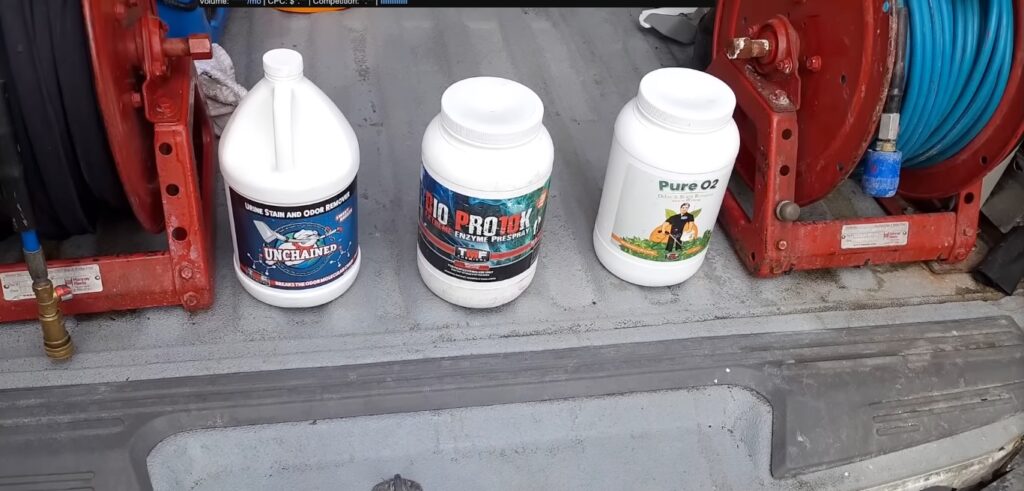
The Products: Building a System That Works Together
Professional carpet cleaning for pet urine isn’t about finding one magic product. It’s about building a system where each product plays a specific role, and the chemistry works together rather than against itself.
For this job, I used four products in a specific sequence:
Step 1: Unchained (Pet Urine Pre-Treatment)
Unchained is a specialized pet urine treatment designed to break down uric acid crystals—the source of persistent odor that survives standard cleaning. I mixed 32 ounces into my sprayer with water, filling it to just under three-quarters of a gallon.
This product needs dwell time to work. The chemical reaction that breaks down uric acid doesn’t happen instantly. I applied Unchained to all areas that lit up under UV inspection and let it sit while I prepared for the next steps. By the time I extracted, it had at least 45 minutes of dwell time—longer than the minimum 30 minutes recommended, but appropriate given the extent of contamination.
Step 2: Bio Pro 10K (Enzyme Pre-Spray)
After treating the urine-affected areas, I addressed the overall carpet with an enzyme-based pre-spray. Enzymes break down organic matter—body oils, food residue, pet dander, and any remaining organic components of the urine contamination.
Enzyme cleaners work differently than chemical cleaners. Rather than dissolving contamination through chemical reaction, enzymes “digest” organic matter biologically. This makes them effective against the types of contamination that chemical cleaners sometimes leave behind.
Step 3: Pure 02 Booster (Odor and Stain Treatment)
I boosted the enzyme pre-spray with Pure 02, an odor and stain remover with citrus components. This addition serves multiple purposes.
First, it provides additional odor treatment beyond what the enzyme cleaner addresses. Second, the citrus components help with body oils—relevant because the high-traffic areas in front of the couch and the kitchen exit showed the wear patterns typical of barefoot traffic and pet movement. Third, I’ve found that carpets treated with this combination look noticeably brighter once dry. The colors seem to “pop” more than with enzyme cleaner alone.
Step 4: Ultimate All Fiber Rinse (Acid Rinse)
This is where pH balancing comes in—a concept many homeowners haven’t heard of, but one that significantly affects cleaning results and how quickly carpet resoils.
Understanding pH: Why It Matters for Pet Urine Cleaning
pH measures how acidic or alkaline a substance is, on a scale from 0 (highly acidic) to 14 (highly alkaline), with 7 being neutral.
Here’s why this matters for carpet cleaning:
The pH of Cleaning Products
Different cleaning products have different pH levels, and that affects what they’re good at removing:
- Unchained (pet treatment): pH around 6 (slightly acidic)
- Bio Pro 10K (enzyme cleaner): pH around 12 (alkaline)
- P02 booster: pH around 11 (alkaline)
When I apply the enzyme pre-spray and booster after the pet treatment, I’m raising the pH of the carpet significantly. Alkaline cleaners are effective at breaking down oils and organic soils, which is why they’re used—but leaving carpet in an alkaline state creates problems.
Why Alkaline Residue Causes Resoiling
Carpet left with alkaline residue attracts and holds soil. The high pH creates a sticky condition that grabs onto dirt as people walk across it. Carpets cleaned without proper rinsing often look great initially, then seem to get dirty again faster than they should. This rapid resoiling isn’t because the carpet wasn’t cleaned well—it’s because alkaline residue was left behind.
The Acid Rinse Solution
After cleaning with alkaline products, I rinse with an acid-based rinse (Ultimate All Fiber Rinse) that brings the carpet’s pH back toward neutral. This rinse is formulated to:
- Neutralize alkaline residue
- Prevent rapid resoiling
- Dry to a non-sticky crystal that doesn’t attract dirt
- Work safely on all carpet fiber types
For this job, the acid rinse also complemented the pet treatment. Since the Unchained product is slightly acidic, finishing with an acid rinse created a consistent pH environment throughout the carpet—optimal for the uric acid breakdown process to complete as the carpet dries.
The Takeaway for Homeowners
When evaluating carpet cleaning services, ask about their rinse process. Cleaners who extract with plain water or skip the rinse step entirely may leave your carpet looking clean initially but prone to rapid resoiling. A proper rinse—whether acid-based or neutralizing—makes a measurable difference in how long your carpet stays clean.
The Process: Step-by-Step Sequence
With the products selected based on the UV inspection findings, here’s how the actual cleaning process unfolded:
1. Vacuuming
Every professional carpet cleaning job should start with thorough vacuuming. The carpet in this home had been in an empty house, so I blew it out with an air compressor first to remove loose debris, then vacuumed thoroughly.
Vacuuming removes dry soil that would otherwise turn into mud when wet cleaning begins. It also lifts carpet fibers for better cleaning solution penetration. Skipping this step makes every subsequent step less effective.
2. Pre-Edge Cleaning
Carpet edges along walls accumulate debris that the vacuum’s main head doesn’t reach effectively. I edged the entire living room and dining area to remove buildup along the baseboards. This detail work isn’t always visible in the final result, but it’s the difference between a thorough job and a surface-level one.
3. Pet Treatment Application (Unchained)
With the carpet prepped, I applied the pet urine treatment to all areas identified under UV inspection. The key here is coverage and saturation—the product needs to reach everywhere the urine reached, which means applying enough volume to penetrate through the carpet fibers to the backing.
I then let this dwell while moving to the next step. Dwell time isn’t optional with pet treatments. The chemical reaction that breaks down uric acid crystals takes time.
4. Enzyme Pre-Spray Application (Bio Pro 10K + P02)
While the pet treatment dwelled on the affected areas, I applied the enzyme pre-spray with P02 booster to the overall carpet. This addresses general soil, body oils, and provides additional treatment for the areas where pet contamination and regular soil overlap.
5. CRB Agitation
After pre-spray application, I used a counter-rotating brush machine (CRB) to work the cleaning solutions into the carpet fibers. The mechanical agitation serves multiple purposes:
- Distributes cleaning solution evenly through the carpet pile
- Loosens embedded soil from carpet fibers
- Brings contamination to the surface for easier extraction
- Provides additional contact between cleaning solutions and soiled areas
Something interesting happened at this stage. After running the CRB—before any extraction—the carpet already looked dramatically different. The combination of proper chemistry and mechanical agitation had visibly transformed the carpet’s appearance.
This is common with the right product combination. I’ve had customers walk in at this stage and ask if I’m finished. The answer is no—extraction is still required to remove all the loosened contamination and cleaning solution. But the visible improvement before extraction demonstrates how much of the cleaning is happening chemically rather than just mechanically.
6. Hot Water Extraction
The final step is extracting everything: loosened soil, cleaning solutions, broken-down urine crystals, and rinse water. I used my acid rinse in the extraction process, which simultaneously removes contamination and neutralizes the carpet’s pH.
Hot water extraction provides the suction power to pull contamination from deep in the carpet structure. This is what separates professional cleaning from surface methods—we’re not just cleaning the fiber tips, we’re extracting from the full depth of the carpet pile and, to some extent, the backing.
7. Drying
After extraction, the carpet needs to dry. In this empty home, air circulation was good and the carpet would dry within a few hours. In occupied homes, running fans or air conditioning speeds the drying process.
Proper extraction leaves carpet damp, not soaking. If carpet is wet enough to squish underfoot after cleaning, too much moisture was applied or extraction wasn’t thorough enough. Excess moisture creates its own problems, including potential mold growth in the pad.
Setting Realistic Expectations
Professional pet urine treatment is highly effective, but it’s not magic. Here’s what homeowners should realistically expect:
What Professional Cleaning Accomplishes
Odor elimination in most cases. When urine contamination is limited to the carpet and pad—and hasn’t reached the subfloor—proper treatment eliminates odor. The chemistry breaks down the uric acid crystals that cause the smell, and extraction removes the byproducts.
Significant stain improvement. Most pet stains lighten dramatically or disappear entirely with proper treatment. Fresh stains respond better than old stains, and some stains respond better than others depending on the pet’s diet and the carpet’s dye stability.
Restored carpet appearance. Beyond the stain spots themselves, pet-affected carpet often looks generally dull and dingy. Full treatment restores the carpet’s overall appearance, often making it look better than the homeowner expected.
What Has Limitations
Severe contamination. When urine has soaked through the pad into the subfloor—common with repeated accidents in the same spot or very large pets—carpet cleaning alone may not eliminate odor completely. The subfloor itself may need treatment, or in extreme cases, the affected section of carpet and pad may need replacement.
Permanent staining. Some stains won’t fully disappear. On this job, there were areas with yellow hues that didn’t budge despite proper treatment. The contamination was removed and the odor was addressed, but the visible stain remained. This happens when urine has chemically altered the carpet dye itself—no amount of cleaning can reverse that chemical change.
Old, set-in damage. Fresh accidents respond better to treatment than old ones. Urine that has been sitting for months or years has had time to fully crystallize, bond with carpet fibers, and potentially affect the carpet backing and pad. Treatment is still worthwhile, but results may be less complete than with recent contamination.
How to Know If Your Situation Is Treatable
For significant pet urine issues, consider having a professional inspect with UV light before committing to cleaning. This assessment reveals the true extent of contamination and allows for honest conversation about expected results. A trustworthy cleaner will tell you if replacement makes more sense than cleaning—not because they don’t want your business, but because setting realistic expectations matters more than selling a job that won’t satisfy.
Related: When Heavy Soil Is the Problem
This article covers pet urine removal — but what if the carpet is heavily soiled rather than urine-contaminated? Heavy soil requires the opposite chemical approach: high-pH alkaline pre-spray to cut through oils, citrus solvents to release impacted dirt, and alkaline rinse rather than acid rinse.
Read our companion article: How Professionals Clean Heavily Soiled Carpet: When Dirt — Not Stains — Is the Problem
That article covers apartment turnovers, why soil needs different chemistry than pet contamination, the role of heat in extraction, and what property managers should realistically expect from neglected carpet.
Why Chemistry Matters More Than Elbow Grease
One thing this job illustrated clearly: proper chemistry does most of the work. The dramatic improvement visible after CRB agitation—before extraction—demonstrated that the right products, applied correctly with appropriate dwell time, transform carpet more effectively than aggressive scrubbing with inferior products.
This is why professional carpet cleaning costs what it does. It’s not just about equipment (though professional extractors outperform rental machines significantly). It’s about:
- Product knowledge: Understanding which products to use for which problems
- System thinking: Building a product combination where the chemistry works together
- Proper application: Correct dilution ratios, application volumes, and dwell times
- pH awareness: Understanding how to balance carpet chemistry for optimal results and longevity
- Experience: Recognizing what a situation requires before starting work
A homeowner with a rental machine and store-bought cleaner doesn’t have access to professional-grade products—and wouldn’t know how to combine them effectively even if they did. This isn’t a criticism; it’s simply why professional cleaning exists as a service.
Frequently Asked Questions
How can I tell if my carpet has pet urine that I’m not seeing?
The most reliable method is UV (blacklight) inspection. Pet urine fluoresces under ultraviolet light, revealing contamination that’s invisible in normal lighting. You can purchase inexpensive UV flashlights online, though professional-grade UV lights reveal contamination more clearly. Another indicator is odor that seems to come and go—especially stronger on humid days—which suggests uric acid crystals are present and reactivating with moisture.
Why does pet odor come back after I clean the carpet myself?
Most consumer carpet cleaning products clean the carpet fibers but don’t break down uric acid crystals embedded in the carpet backing and pad. When you clean, you remove surface contamination and the carpet smells better initially. But the crystals remain, and when humidity rises, they release odor again. Professional pet urine treatment uses chemistry specifically designed to break down these crystals rather than just cleaning around them.
How long should carpet cleaning products sit before extraction?
Dwell time varies by product type. Standard pre-sprays may need only a few minutes. Pet urine treatments typically require 30-45 minutes or longer to allow the chemical reaction that breaks down uric acid to complete. Enzyme cleaners continue working as long as they remain moist. Professional cleaners know the appropriate dwell time for each product they use and plan their workflow accordingly.
What does pH have to do with carpet cleaning?
pH affects both how effectively cleaning products work and how quickly carpet resoils afterward. Alkaline cleaners (high pH) are effective at removing oils and organic soils, but leaving carpet in an alkaline state makes it attract and hold new soil quickly. Professional cleaners typically finish with an acid rinse or neutralizing rinse to bring carpet back toward neutral pH, which keeps it cleaner longer.
Can pet urine damage carpet permanently?
Yes, in several ways. Urine can chemically alter carpet dye, causing permanent discoloration even after cleaning. It can break down carpet backing material over time. In severe cases, it can damage the pad and subfloor beneath the carpet, creating odor problems that carpet cleaning alone can’t solve. Early treatment of accidents—and prompt professional cleaning for any significant contamination—minimizes the chance of permanent damage.
How often should I have carpets professionally cleaned if I have pets?
Most pet owners benefit from professional cleaning every 6-12 months, compared to the 12-18 months typically recommended for pet-free households. Regular professional cleaning removes pet dander, hair, tracked-in soil, and any minor accidents before they become major problems. If your pet has a known accident, spot treatment followed by professional cleaning is better than waiting for your scheduled appointment.
What’s the difference between enzyme cleaners and other carpet cleaners?
Traditional carpet cleaners use chemical reactions to break down and dissolve contamination. Enzyme cleaners use biological action—enzymes that “digest” organic matter rather than dissolving it chemically. This makes enzyme cleaners particularly effective for organic contamination like pet urine, food spills, blood, and body oils. Many professional systems use enzyme cleaners in combination with other products to address different contamination types simultaneously.
Why does carpet look better after scrubbing but before extraction?
When proper cleaning products are applied and agitated into carpet, the chemistry begins breaking down contamination immediately. Mechanical agitation distributes the cleaning solution throughout the carpet pile and loosens embedded soil. The visible improvement at this stage demonstrates how much work the chemistry is doing. Extraction then removes all the loosened contamination, cleaning solution, and suspended soil—completing the process and leaving carpet clean rather than just looking cleaner.
Should I clean pet stains myself or call a professional?
For fresh accidents, immediate homeowner response is valuable—blot the moisture, apply an enzyme-based cleaner, and allow it to dry. This limits how deeply the urine penetrates. However, for any significant contamination, old stains, recurring odor problems, or multiple accident areas, professional treatment is significantly more effective. The product systems, application knowledge, and extraction equipment that professionals use simply aren’t available to consumers.
How do I know if a carpet cleaner will actually address pet urine properly?
Ask specifically about their pet urine treatment process. A knowledgeable cleaner should be able to explain: what products they use for pet treatment (it should be different from their standard cleaning products), why dwell time matters, and how they address pH balancing. Ask if they inspect with UV light before cleaning. If a cleaner treats pet urine the same way they treat regular soil—just “adding” a pet deodorizer—that’s a sign they may not achieve the results you need.
About Black Diamond Services
Black Diamond Services is a family-owned carpet and house cleaning company based in Oakdale, California, serving Stanislaus and San Joaquin counties since 2017. Founded by Nolan and Janel Hill, Black Diamond has earned over 275 five-star reviews by treating every home like our own.
We use commercial-grade equipment and professional product systems to deliver results that consumer-grade cleaning can’t match. For pet urine situations, we begin with UV inspection to assess the true extent of contamination, then build a treatment plan using the multi-step process described in this article—not a one-size-fits-all approach that ignores the specific chemistry your carpet needs.
Our services include carpet cleaning, house cleaning, tile and grout cleaning, rug cleaning, upholstery cleaning, hardwood floor cleaning, luxury vinyl plank cleaning, natural stone cleaning, and dryer vent cleaning throughout Oakdale, Modesto, Turlock, Tracy, Manteca, Ripon, Riverbank, Hughson, Escalon, Salida, Denair, and surrounding Central Valley communities.
Every job includes our 100% satisfaction guarantee, transparent pricing with no hidden fees, and the personalized service you’d expect from a local, family-operated business.
Dealing with pet odor or stains that won’t go away? Call Black Diamond Services at (209) 264-8898 for a free assessment. We’ll tell you honestly what professional cleaning can accomplish for your situation.
Last updated: March 2026