
How Professionals Clean Heavily Soiled Carpet: When Dirt — Not Stains — Is the Problem
By Nolan Hill, Black Diamond Services | Professional Carpet Cleaning in Stanislaus and San Joaquin Counties
Summary: Heavily soiled carpet requires a different cleaning approach than stained or pet-damaged carpet. This article walks through an apartment turnover cleaning where years of impacted dirt, body oils, and food debris had built up in high-traffic areas. For property managers and landlords, understanding how professional cleaning addresses severe soil — and when carpet is worth saving versus replacing — helps make better decisions about unit turnovers. We cover high-pH chemistry, the role of heat and citrus solvents, why multiple extraction passes matter, and how to set realistic expectations for neglected carpet.
The Job: An Apartment Turnover With Years of Buildup
Recently, I cleaned carpet in an apartment unit being turned over between tenants. The property manager mentioned it had been “cleaned in November” — but the moment I walked in, I knew whoever did that job either cut corners or used inadequate methods.
The carpet was sticky underfoot. You could hear shoes pulling against the fibers walking through the hallway and living room. That sound tells me one thing: heavy soil buildup that previous cleaning didn’t remove, combined with residue that’s now attracting more dirt.
The living room and hallway had taken the worst of it — years of foot traffic grinding dirt deep into the carpet fibers. The bedrooms weren’t as bad, but still needed attention. There were food stains throughout, including what turned out to be toothpaste in one room and actual pepperoni I had to vacuum up in another. The carpet along one doorway was frayed and pulling away from the tack strip.
This wasn’t a pet situation. No urine odors, no UV light inspection needed. This was pure soil — dirt, body oils, food debris, and whatever else accumulates when carpet goes too long without proper cleaning. And that distinction completely changes the chemistry I use.
Why Heavy Soil Requires Different Chemistry Than Pet Urine
If you’ve read our article on how professionals remove pet urine from carpet, you know that pet contamination requires specialized treatment focused on breaking down uric acid crystals and finishing with an acid rinse to complement that chemistry.
Heavy soil is a different problem requiring the opposite approach.
The Nature of Soil Contamination
When dirt accumulates in carpet over time, it doesn’t just sit on the fiber tips. Foot traffic grinds particles deep into the carpet pile, where they become compacted and bonded to fibers through a combination of:
- Body oils from bare feet and skin contact
- Cooking oils that become airborne and settle on surfaces
- Sticky residue from spills, tracked-in substances, and previous cleaning products
- Fine particulates that work their way down to the carpet backing
This compacted soil creates what I call “impacted dirt” — contamination that’s essentially glued to carpet fibers and won’t release with standard cleaning chemistry.
Why Alkaline Chemistry Works for Soil
Oils are the binding agent that holds soil to carpet fibers. To release impacted dirt, you need to cut through those oils first. That’s where alkaline (high-pH) chemistry comes in.
Alkaline cleaners are effective degreasers. They break down oils and emulsify greasy contamination, releasing the grip that holds dirt particles to fibers. The higher the pH, the more aggressive the degreasing action.
For this apartment, I used the strongest pre-spray in my arsenal — a 12.5 pH pre-treatment. That’s significantly more alkaline than standard carpet cleaning products, which typically run in the 9-11 pH range. The severe soil level justified the aggressive chemistry.
Alkaline Rinse vs. Acid Rinse
Here’s where the approach diverges completely from pet urine treatment.
With pet urine, I finish with an acid rinse because:
- The pet treatment products are slightly acidic
- Acid rinse complements the uric acid breakdown process
- The carpet chemistry needs to stay in the acidic range for odor elimination
With heavy soil, I finish with an alkaline neutralizing rinse because:
- The pre-spray is highly alkaline (12.5 pH)
- An alkaline rinse (around 8-8.5 pH) helps neutralize without swinging too far
- The soil contamination responds better to consistent alkaline chemistry throughout
This is why professional carpet cleaning isn’t one-size-fits-all. The contamination type determines the entire chemical approach — products, pH levels, and rinse selection.
The Products: Building a Heavy-Soil System
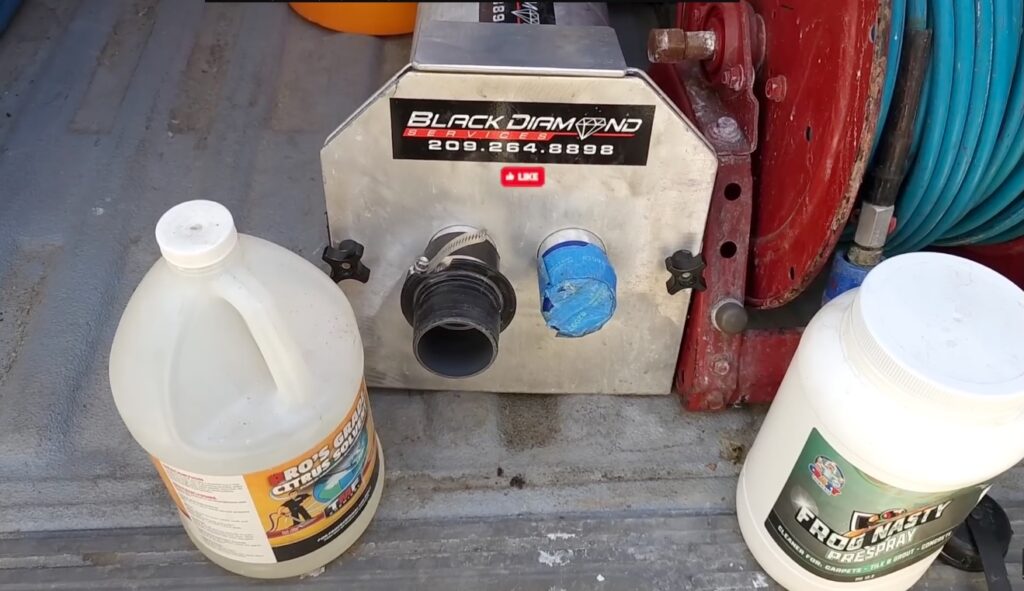
For this apartment turnover, I used four products working together:
Frog Nasty Pre-Spray (12.5 pH)
This is my heavy-hitter for severe soil situations. At 12.5 pH, it’s one of the most alkaline pre-sprays available, designed specifically for neglected carpet where standard products won’t cut through the buildup.
I mixed it at full strength — no dilution — because the soil level demanded maximum cleaning power. For less severe jobs, diluting the product makes sense. For this apartment, I needed everything it could deliver.
The high pH means this product is aggressive. It’s not what I’d use on lightly soiled residential carpet where gentler chemistry is appropriate. But for apartment turnovers where carpet has been neglected for years, it’s the right tool.
Citrus Solvent (Oil Cutter)
I boosted the pre-spray with citrus solvent — about nine ounces per gallon, which is near the maximum recommended concentration. Citrus solvents are natural degreasers that help cut through oils that alkaline cleaners alone might not fully release.
Walking through the apartment, I could tell this carpet had significant oil content. The sticky, tacky feel underfoot is the giveaway. That stickiness is oil-bound soil, and citrus solvent helps break that bond so extraction can remove it.
P02 Booster (Organic Stain Treatment)
Given the food stains throughout — and the likelihood of organic contamination in an apartment with this much general neglect — I added P02 as a booster. This product contains hydrogen peroxide and citrus components that help with organic staining.
The hydrogen peroxide provides mild oxidizing action that brightens fibers and helps break down organic matter. It’s not a bleaching agent at these concentrations, but it contributes to overall cleaning effectiveness and helps carpet look brighter when dry.
Alkaline Neutralizing Rinse (8-8.5 pH)
For the rinse cycle, I used an alkaline neutralizing rinse rather than an acid rinse. At around 8-8.5 pH, this rinse is still slightly alkaline — which complements the high-pH pre-spray rather than fighting against it.
The rinse serves multiple purposes:
- Removes pre-spray residue that would otherwise attract new soil
- Helps suspend and extract loosened contamination
- Leaves carpet fibers in a neutral state that resists rapid resoiling
Skipping the rinse — or using plain water — would leave alkaline residue in the carpet that causes it to resoil quickly. Proper rinsing is what separates professional results from “cleaned but gets dirty again fast.”
The Role of Heat in Heavy-Soil Extraction
Heat is one of the most underappreciated factors in carpet cleaning. For heavy soil removal, high extraction temperatures make a measurable difference.
How Heat Helps
Hot water does several things that cold or warm water can’t:
- Increases chemical activity — cleaning products work more effectively at higher temperatures
- Loosens oil bonds — heat helps release the oily residue binding soil to fibers
- Reduces water viscosity — thinner water penetrates carpet pile more effectively
- Improves extraction — hot water releases from fibers more completely during vacuuming
For this job, I ran my extraction at over 200 degrees at the wand. My truck-mounted system heats water to 240-250 degrees, but you lose heat through the supply lines between the truck and the cleaning wand.
Managing Heat Loss
Several factors affect how much heat reaches the carpet:
Line length: Longer hose runs mean more heat loss. For jobs where I need maximum heat, I’ll run direct to the machine rather than through a hose reel.
Line insulation: I use heat-retention supply lines (heat saber lines) that hold temperature better than standard steam lines. This can mean 5+ degrees more heat at the wand.
Ambient conditions: Hot days mean less heat loss; cold days mean more. In extreme cold, pre-warming lines before extraction helps.
For heavy soil jobs like this apartment, I pay attention to heat management. The combination of aggressive chemistry and high extraction temperature is what cuts through years of neglected buildup.
The Process: Step-by-Step for Heavy Soil
1. Vacuuming
Every job starts with dry soil removal. Interestingly, this apartment didn’t produce much vacuum debris despite being heavily soiled. That told me the contamination was mostly impacted dirt bonded to fibers rather than loose particles sitting on top.
This distinction matters: loose soil vacuums out easily, but impacted soil requires wet extraction. The vacuum step still matters because any loose debris removed dry doesn’t turn into mud when wet cleaning begins.
2. Hot Pre-Spray Application
I mixed the Frog Nasty pre-spray with hot water and added the citrus solvent and P02 booster. For a space this size, I would normally use less than a full gallon of pre-spray mixture. For this job, I used the full gallon to ensure complete coverage and saturation.
Heavy soil needs liberal pre-spray application. Skimping on product to save money results in mediocre results. The chemistry needs contact with contamination throughout the carpet pile to work effectively.
3. CRB Agitation
After pre-spray application, I used a counter-rotating brush machine (CRB) to work the cleaning solution into the carpet fibers.
The CRB weighs about 40-45 pounds and uses two brushes spinning in opposite directions. This action:
- Distributes pre-spray evenly throughout the carpet pile
- Works cleaning solution into contact with embedded soil
- Loosens compacted dirt from carpet fibers
- Brings contamination to the surface for extraction
For severely soiled areas, I made two passes with the CRB rather than one. Some sections needed the additional agitation to loosen years of buildup.
An interesting thing happened at this stage — something I see on heavy soil jobs. After CRB agitation, the carpet already looked significantly better. The toothpaste stain in the bedroom had essentially disappeared just from pre-spray and brushing.
Clients sometimes see this and ask, “Are you done?” The answer is no — extraction still needs to remove all the loosened contamination and cleaning product. But the visible transformation before extraction demonstrates how much work the chemistry and agitation are doing.
4. Multiple-Pass Extraction
For standard residential cleaning, one or two extraction passes typically suffice. For this apartment, I made three to four passes over most areas — and watched the recovery tank to confirm I was still pulling dirty water on each pass.
When you’re extracting heavily soiled carpet and seeing contamination continue to come out on the third and fourth pass, you know the soil level was severe. Stopping after one or two passes would have left significant contamination behind.
I ran the extraction with alkaline neutralizing rinse at over 200 degrees. The combination of heat, proper rinse chemistry, and multiple passes is what produces results on carpet this neglected.
5. Equipment Sanitation
This is worth mentioning because it affects every subsequent job. After cleaning carpet this soiled, everything that contacted the carpet and waste water gets thoroughly cleaned:
- Extraction wand: rinsed and sanitized
- Recovery tank: emptied, rinsed, sanitized
- Supply lines: flushed
- CRB brushes: removed and washed with hot water from the extraction system
I don’t carry contamination from a heavily soiled apartment into the next client’s home. This is basic professionalism, but it takes time that some cleaners skip.
The Results: What to Realistically Expect
The transformation on this apartment was dramatic. Carpet that had been sticky underfoot and visibly grimy came out looking almost new in most areas.
But “almost new” isn’t “new.” Here’s the honest assessment:
What Heavy-Soil Cleaning Accomplishes
Removes impacted dirt. The sticky, tacky feel disappeared. Walking on the carpet after cleaning felt like carpet should feel — soft, clean, no resistance. The soil that had been ground into fibers for years was extracted.
Restores appearance. The carpet looked dramatically different — brighter, more uniform, the original color visible again rather than masked by gray-brown grime.
Eliminates odors. Soil-contaminated carpet often smells musty or stale. Removing the contamination removes the smell.
Extends usable life. Carpet that looked like it needed immediate replacement became acceptable for another tenant cycle.
What Has Limitations
Permanent damage remains. In this apartment, one doorway area had carpet fraying away from the tack strip. Cleaning doesn’t repair physical damage. That area would need repair — re-stretching at minimum, or patching.
Traffic patterns may show. Areas with heaviest wear often have fiber damage from years of foot traffic grinding dirt against fibers. Cleaning removes the dirt but can’t reverse fiber damage. These areas may still look worn even when clean.
Some stains persist. While most of the food stains came out (the toothpaste disappeared completely), some discoloration may remain where staining substances have chemically bonded with carpet dyes.
When Replacement Makes More Sense
On this job, I mentioned to the property manager that the living room carpet realistically should be replaced. The wear level, fiber damage, and overall condition meant that even professional cleaning was a temporary solution.
That said, cleaning bought time. If the unit was being rented again soon and carpet replacement wasn’t in the budget, professional cleaning made the carpet acceptable rather than embarrassing. The cost difference between cleaning and replacement is significant — a few hundred dollars versus potentially a thousand or more.
For property managers, the calculation is: Does cleaning produce acceptable results for the cost? On this job, the answer was yes, despite the carpet’s underlying wear issues.
Special Considerations for Property Managers and Landlords
Apartment turnovers present specific challenges that differ from typical residential cleaning.
Unknown History
With homeowner clients, I can ask questions: How long since the last cleaning? Any pet accidents? What products have you used? With turnovers, you’re often working blind. This apartment was supposedly cleaned a few months prior, but the condition told a different story.
Unknown history means starting with inspection and adjusting the approach based on what you find — not assuming any particular situation.
Time Pressure
Property managers often need fast turnovers to minimize vacancy loss. Professional cleaning takes time to do correctly — proper dwell time for pre-spray, multiple extraction passes for heavy soil, adequate drying time before the next tenant moves in.
Rushing the process produces inferior results. If cleaning is worth doing, it’s worth doing correctly. Build realistic timeframes into turnover schedules.
Deposit Considerations
Cleaning costs versus deposit deductions is a constant calculation. Professional cleaning for this apartment cost far less than carpet replacement would have. If the carpet is salvageable, cleaning is almost always the more economical choice — and proper cleaning may save carpet that surface-level cleaning would fail on.
When to Recommend Replacement
A trustworthy cleaning service will tell you when carpet isn’t worth cleaning. Signs that replacement makes more sense than cleaning:
- Carpet is physically damaged (tears, fraying, delamination)
- Pet urine has reached the subfloor beneath the pad
- Fiber damage is so severe that traffic patterns won’t improve with cleaning
- Carpet is simply at end of life from age and wear
On this job, I noted the areas where replacement would be needed even though I was able to clean the carpet successfully overall.
Equipment Matters: Why Professional Results Differ
A property manager once told me they’d had a previous company clean this same apartment with poor results. Without seeing that work, I can speculate on why: equipment and chemistry differences.
Truck-Mounted vs. Portable Extraction
I use a truck-mounted extraction system that delivers:
- 200+ degree water temperature at the wand
- Higher vacuum pressure for better soil removal
- Larger waste capacity for multi-room jobs
- Consistent performance without overheating
Portable extractors (including rental machines) typically deliver:
- 100-140 degree water
- Lower vacuum pressure
- Limited tank capacity
- Performance degradation as the unit heats up
For lightly soiled carpet, portable equipment may produce acceptable results. For heavy soil like this apartment, the difference between professional truck-mounted extraction and portable equipment is dramatic.
Product Quality
Consumer carpet cleaning products are formulated for safety and ease of use, not maximum effectiveness. Professional products — like the 12.5 pH pre-spray I used here — are more aggressive and more effective, but require training to use correctly.
The citrus solvent, P02 booster, and alkaline rinse I used aren’t available at hardware stores. Professional products, properly combined, produce results that consumer products can’t match.
Frequently Asked Questions
How do I know if my carpet has heavy soil versus other problems?
Heavy soil typically shows as overall dinginess, darkening in traffic areas, and a tacky or sticky feel underfoot. If carpet feels like it’s grabbing at your shoes, that’s oil-bound soil. Pet urine contamination usually involves specific spots and distinct odor. Staining appears as discolored areas that stand out from surrounding carpet. Heavy soil is more uniform — the whole traffic area looks worse than low-traffic areas.
Why does my carpet get dirty again so quickly after cleaning?
Rapid resoiling usually indicates one of two problems: residue left behind from cleaning products, or carpet that wasn’t thoroughly cleaned in the first place. Alkaline cleaning products not properly rinsed leave sticky residue that attracts new soil. Professional cleaning with proper rinse chemistry — and adequate extraction — prevents rapid resoiling. If your carpet gets dirty within weeks of cleaning, the cleaning process likely wasn’t complete.
Can heavily soiled carpet be restored to like-new condition?
Heavy soil can be removed, but underlying damage cannot be reversed. If carpet fibers have been damaged by years of foot traffic grinding dirt against them, cleaning removes the dirt but the fiber damage remains. Heavily soiled carpet can look dramatically better after professional cleaning, but may not look “new” if physical fiber damage has occurred.
How long should carpet cleaning products sit before extraction?
Dwell time depends on the product and soil level. For standard pre-sprays on moderate soil, a few minutes may suffice. For heavy-soil situations with high-pH pre-sprays, I let the chemistry work for 10-15 minutes before extraction. The agitation step (CRB) also provides working time for the chemistry. Adequate dwell time allows cleaning products to break down soil bonds before you try to extract.
What temperature should extraction water be for heavy soil?
Higher is better for heavy soil removal. Professional truck-mounted equipment can deliver 200+ degrees at the wand. Rental machines and portable extractors typically deliver 100-140 degrees. The temperature difference significantly affects cleaning effectiveness, especially on oil-bound soil. If you’re having carpet professionally cleaned for heavy soil, ask about their extraction temperature.
Why does professional carpet cleaning cost more than rental machine cleaning?
Professional cleaning includes: commercial-grade equipment with higher performance, professional products unavailable to consumers, trained technicians who adjust approach based on conditions, proper rinse chemistry to prevent resoiling, and accountability for results. Rental machine cleaning costs less but delivers less. For heavy soil situations especially, the difference in results often justifies the cost difference.
How often should carpet in rental units be professionally cleaned?
Between every tenant is ideal, but at minimum annually for occupied units and at every turnover for vacating tenants. Waiting until carpet looks heavily soiled means soil has had time to become impacted and bonded to fibers, making cleaning more difficult and results less complete. Regular professional cleaning maintains carpet appearance and extends replacement cycles.
Can I use regular carpet cleaner on heavily soiled carpet?
Consumer carpet cleaners are formulated for light to moderate soil. They typically don’t have the pH or chemical composition to cut through heavy, oil-bound soil. Using regular cleaner on heavily soiled carpet may produce some improvement but won’t address impacted dirt. You’ll likely see results plateau and remaining soil that just won’t release with consumer chemistry.
Why did my carpet look clean at first but then get dirty again?
This usually means soil was loosened but not extracted. When cleaning solution breaks soil bonds and agitation loosens contamination, carpet looks better immediately. But if extraction doesn’t remove that loosened soil, it settles back into the carpet as it dries. Proper extraction — often multiple passes on heavy soil — removes what cleaning chemistry has loosened. Incomplete extraction leaves soil behind to re-appear.
How do I know if carpet should be replaced instead of cleaned?
Consider replacement when: carpet is physically damaged (tears, fraying, holes), urine contamination has reached the subfloor, fiber damage makes traffic patterns permanent regardless of cleaning, or carpet age and wear mean even clean carpet looks unacceptable. A trustworthy cleaning service will give you honest assessment. On this job, I cleaned the carpet successfully but noted that the living room area should ultimately be replaced due to wear level.
Related: When Pet Urine Is the Problem
This article covers heavy soil removal — but what if pet urine contamination is the primary concern? Pet urine requires different chemistry and a completely different approach.
Read our companion article: How Professional Carpet Cleaners Remove Pet Urine: A Step-by-Step Walkthrough
That article covers UV inspection for urine detection, why uric acid crystals cause persistent odor, the multi-product pet treatment system, and why pet contamination requires acid rinse rather than the alkaline rinse used for heavy soil.
About Black Diamond Services
Black Diamond Services is a family-owned carpet and house cleaning company based in Oakdale, California, serving Stanislaus and San Joaquin counties since 2017. Founded by Nolan and Janel Hill, Black Diamond has earned over 275 five-star reviews by treating every home like our own.
We work with property managers throughout the Central Valley on apartment turnovers, move-out cleanings, and ongoing maintenance. Our truck-mounted equipment delivers 200+ degree extraction temperature and the vacuum power needed for heavy-soil situations. We adjust our chemistry based on what your carpet actually needs — not a one-size-fits-all approach.
Our services include carpet cleaning, house cleaning, tile and grout cleaning, rug cleaning, upholstery cleaning, hardwood floor cleaning, luxury vinyl plank cleaning, natural stone cleaning, and dryer vent cleaning throughout Oakdale, Modesto, Turlock, Tracy, Manteca, Ripon, Riverbank, Hughson, Escalon, Salida, Denair, and surrounding Central Valley communities.
Every job includes our 100% satisfaction guarantee, transparent pricing with no hidden fees, and the personalized service you’d expect from a local, family-operated business.
Managing rental properties in the Central Valley? Call Black Diamond Services at (209) 264-8898 for turnover cleaning that actually works. We’ll tell you honestly what professional cleaning can accomplish — and when replacement makes more sense.
Last updated: March 2026